Microsoft X SCADPro
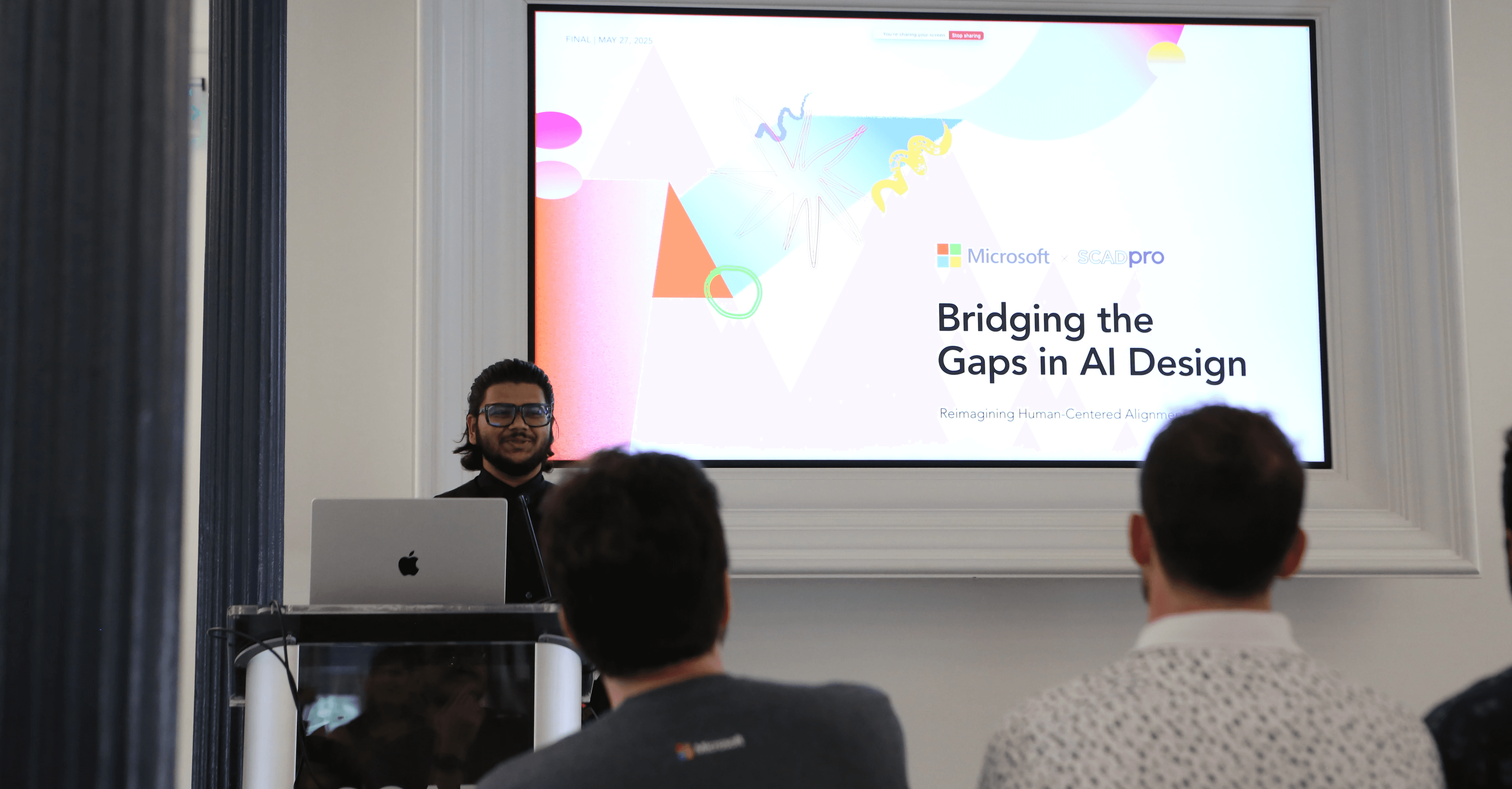
In this SCADPro collaboration with Microsoft’s BIC team, we tackled the growing tension between accelerated AI product development and the time-intensive nature of human-centered design. With shrinking timelines, design teams were unable to follow traditional research and validation processes, leading to product decisions with uncertain user value and ethical risks. Our solution included a strategic framework and agentic system to reinforce newly crafted AI-first design principles at every stage of the design lifecycle.
Client
Microsoft (BIC) X SCADPro Industry Collaboration
Timeline
APR 2025 - JUN 2025
Skills & Methods Used
Agentic AI Systems Thinking
Design Management
Agile Methods
Project Management
UX Strategy
Service Blueprinting
Vibe Coding
AI-First Design Principles
User Journey Mapping
User Testing
Root Cause Analysis
Facilitating Ideation Workshop
External Competition Analysis
Future Casting Methods
Lextant Ideal Exp Framework
Team
Prathamesh Patil (Project Manager) + 19 SCAD Students + Prof. Lee Cody
PROBLEM
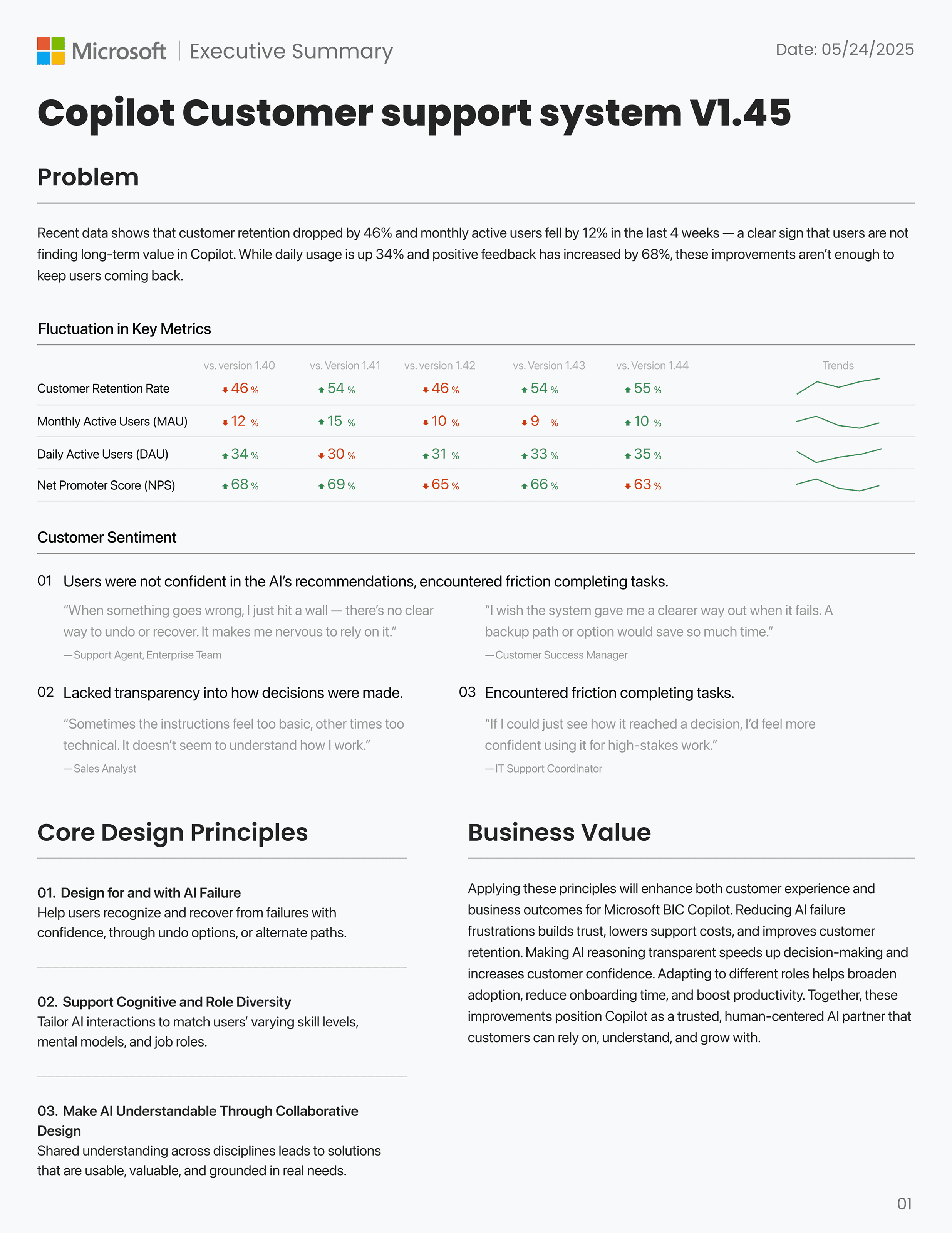
With AI products/ features shipping in crunched timelines, design teams at Microsoft lacked the time to follow traditional design processes, often skipping research, validation, and user feedback. This raised two critical risks:
Delivering features misaligned with real user needs
Violating ethical design practices around AI
The result was a widening gap between business speed and design quality and an urgent need to rethink how responsible design could scale with rapid AI development.
SOLUTION
We created a 3-part solution that supports fast-paced teams without sacrificing ethical, user-centered design:
AI-First Design Principles - A new set of human-centered, AI-native principles to replace traditional design frameworks.
Garden of Principles Card Game - A team ritual to align designers and stakeholders on project-specific principles using printed cards & scenario-based gameplay.
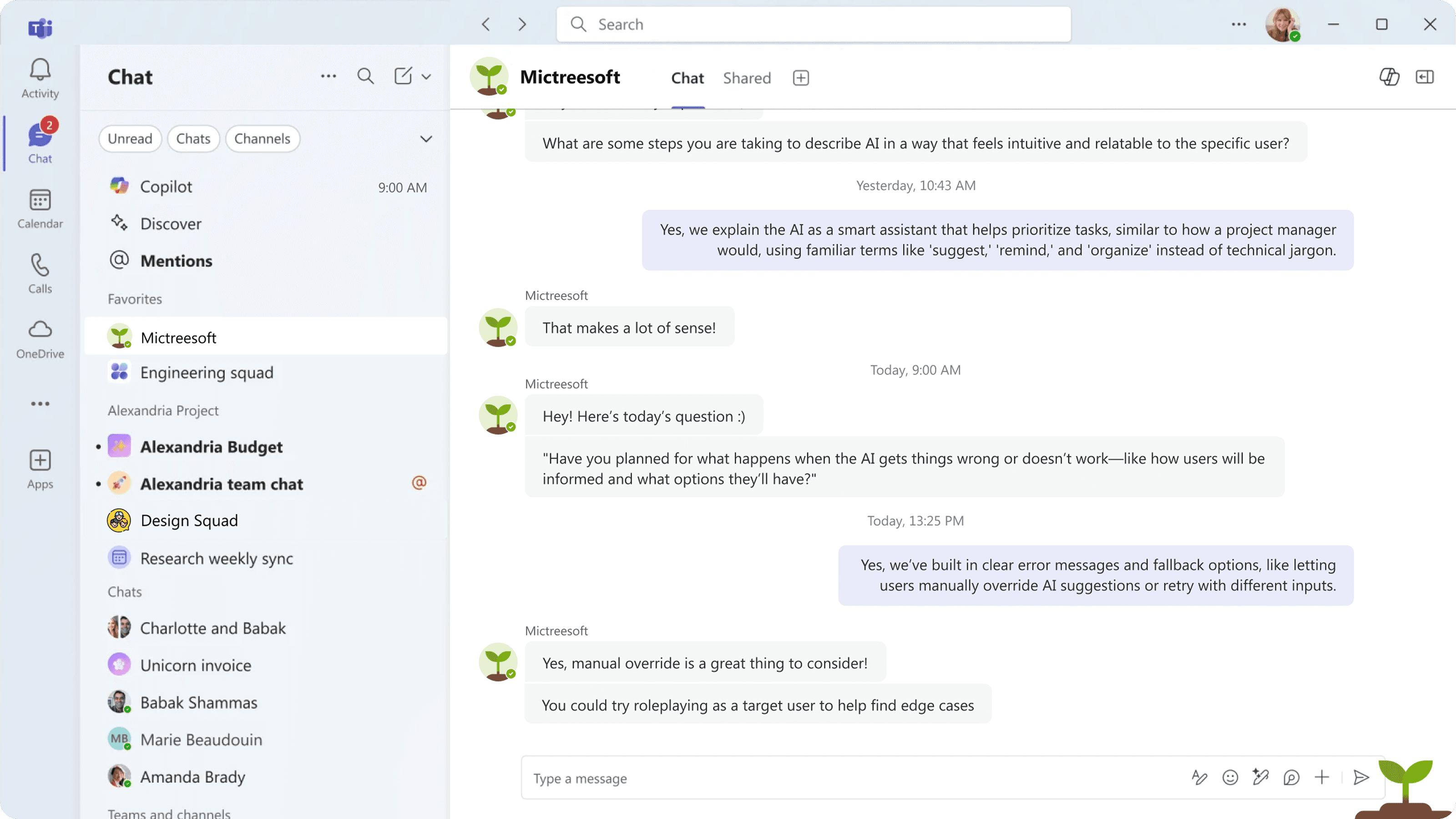
Mictreesoft Tool - A Tamagotchi-inspired digital system that uses micro-interactions and agentic AI to reinforce adherence to design principles in real-time.
VALUE DELIVERED
Empowered Microsoft design teams to practice agile yet ethical design under tight timelines.
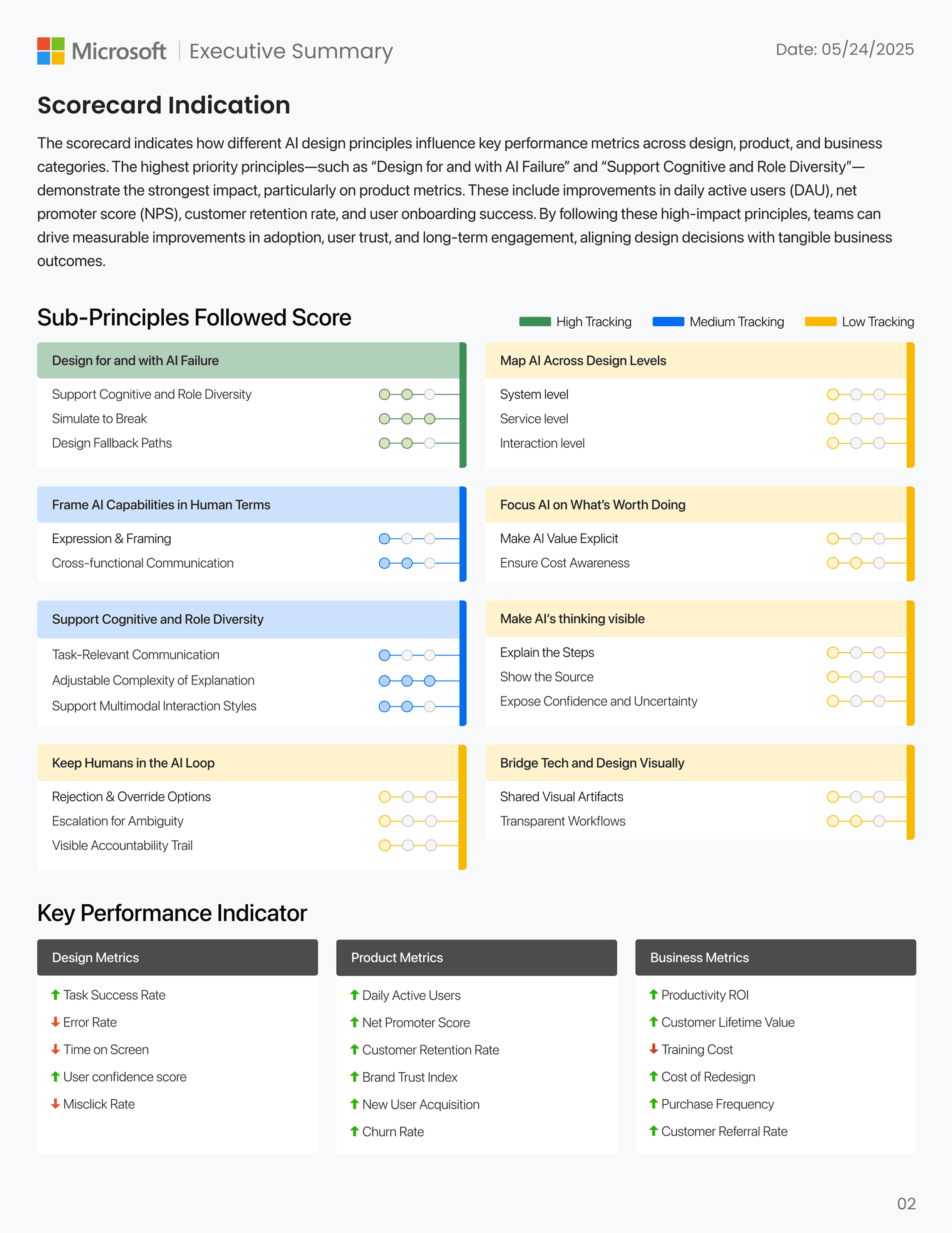
Transformed design principles from abstract values into measurable, behavior-driven metrics.
Delivered a fully printed and interactive toolkit + AI-powered tool that was praised by the client.
Established a new “design adherence layer” that ties practice to real business impact.
APPROACH
The project began with ambiguity and a broad problem space. As Project Manager, I led the team through a structured discovery and iterative design process:
Research Phase: Deep research on AI ethics, design maturity, and internal interviews across Microsoft and external competition among the tech industry.
Insights: Time pressure was universal, but what teams needed was embedded design guidance.
Principle Creation: We crafted the new AI-first design principles, blending AI systems, HCI ethics, and responsible AI guidelines.
Ecosystem Design: Along with the new AI-first design principles we also designed a 3-layered solution, which consisted of principle alignment (game), in-process nudging (tree tool), and project summary (AI report).
Agentic AI Development: I built a crew of AI agents, automating majority of the framework,
Agent 1: Generated custom “question of the day” prompts based on project context and principle weightage.
Agent 2: Quantified adherence via responses to micro-interactions.
Agent 3: Generated a final impact report mapping design behavior to business outcomes.
SUMMARY
In the age of fast-paced AI shipping, responsible design and adherence to design principles is the new validation. This project proved that ethical and user-centered design can co-exist with speed, if we rethink tools, principles, and rituals from the ground up. Our ecosystem not only supported Microsoft’s internal design culture but also introduced a repeatable, data-backed model that blends agentic AI with human design values.
Microsoft X SCADPro
In this SCADPro collaboration with Microsoft’s BIC team, we tackled the growing tension between accelerated AI product development and the time-intensive nature of human-centered design. With shrinking timelines, design teams were unable to follow traditional research and validation processes, leading to product decisions with uncertain user value and ethical risks. Our solution included a strategic framework and agentic system to reinforce newly crafted AI-first design principles at every stage of the design lifecycle.
Client
Microsoft (BIC) X SCADPro Industry Collaboration
Timeline
APR 2025 - JUN 2025
Skills & Methods Used
Agentic AI Systems Thinking
Design Management
Agile Methods
Project Management
UX Strategy
Service Blueprinting
Vibe Coding
AI-First Design Principles
User Journey Mapping
User Testing
Root Cause Analysis
Facilitating Ideation Workshop
External Competition Analysis
Future Casting Methods
Lextant Ideal Exp Framework
Team
Prathamesh Patil (Project Manager) + 19 SCAD Students + Prof. Lee Cody
PROBLEM
With AI products/ features shipping in crunched timelines, design teams at Microsoft lacked the time to follow traditional design processes, often skipping research, validation, and user feedback. This raised two critical risks:
Delivering features misaligned with real user needs
Violating ethical design practices around AI
The result was a widening gap between business speed and design quality and an urgent need to rethink how responsible design could scale with rapid AI development.
SOLUTION
We created a 3-part solution that supports fast-paced teams without sacrificing ethical, user-centered design:
AI-First Design Principles - A new set of human-centered, AI-native principles to replace traditional design frameworks.
Garden of Principles Card Game - A team ritual to align designers and stakeholders on project-specific principles using printed cards & scenario-based gameplay.
Mictreesoft Tool - A Tamagotchi-inspired digital system that uses micro-interactions and agentic AI to reinforce adherence to design principles in real-time.
VALUE DELIVERED
Empowered Microsoft design teams to practice agile yet ethical design under tight timelines.
Transformed design principles from abstract values into measurable, behavior-driven metrics.
Delivered a fully printed and interactive toolkit + AI-powered tool that was praised by the client.
Established a new “design adherence layer” that ties practice to real business impact.
APPROACH
The project began with ambiguity and a broad problem space. As Project Manager, I led the team through a structured discovery and iterative design process:
Research Phase: Deep research on AI ethics, design maturity, and internal interviews across Microsoft and external competition among the tech industry.
Insights: Time pressure was universal, but what teams needed was embedded design guidance.
Principle Creation: We crafted the new AI-first design principles, blending AI systems, HCI ethics, and responsible AI guidelines.
Ecosystem Design: Along with the new AI-first design principles we also designed a 3-layered solution, which consisted of principle alignment (game), in-process nudging (tree tool), and project summary (AI report).
Agentic AI Development: I built a crew of AI agents, automating majority of the framework,
Agent 1: Generated custom “question of the day” prompts based on project context and principle weightage.
Agent 2: Quantified adherence via responses to micro-interactions.
Agent 3: Generated a final impact report mapping design behavior to business outcomes.
SUMMARY
In the age of fast-paced AI shipping, responsible design and adherence to design principles is the new validation. This project proved that ethical and user-centered design can co-exist with speed, if we rethink tools, principles, and rituals from the ground up. Our ecosystem not only supported Microsoft’s internal design culture but also introduced a repeatable, data-backed model that blends agentic AI with human design values.
Microsoft X SCADPro
In this SCADPro collaboration with Microsoft’s BIC team, we tackled the growing tension between accelerated AI product development and the time-intensive nature of human-centered design. With shrinking timelines, design teams were unable to follow traditional research and validation processes, leading to product decisions with uncertain user value and ethical risks. Our solution included a strategic framework and agentic system to reinforce newly crafted AI-first design principles at every stage of the design lifecycle.
Client
Microsoft (BIC) X SCADPro Industry Collaboration
Timeline
APR 2025 - JUN 2025
Skills & Methods Used
Agentic AI Systems Thinking
Design Management
Agile Methods
Project Management
UX Strategy
Service Blueprinting
Vibe Coding
AI-First Design Principles
User Journey Mapping
User Testing
Root Cause Analysis
Facilitating Ideation Workshop
External Competition Analysis
Future Casting Methods
Lextant Ideal Exp Framework
Team
Prathamesh Patil (Project Manager) + 19 SCAD Students + Prof. Lee Cody
PROBLEM
With AI products/ features shipping in crunched timelines, design teams at Microsoft lacked the time to follow traditional design processes, often skipping research, validation, and user feedback. This raised two critical risks:
Delivering features misaligned with real user needs
Violating ethical design practices around AI
The result was a widening gap between business speed and design quality and an urgent need to rethink how responsible design could scale with rapid AI development.
SOLUTION
We created a 3-part solution that supports fast-paced teams without sacrificing ethical, user-centered design:
AI-First Design Principles - A new set of human-centered, AI-native principles to replace traditional design frameworks.
Garden of Principles Card Game - A team ritual to align designers and stakeholders on project-specific principles using printed cards & scenario-based gameplay.
Mictreesoft Tool - A Tamagotchi-inspired digital system that uses micro-interactions and agentic AI to reinforce adherence to design principles in real-time.
VALUE DELIVERED
Empowered Microsoft design teams to practice agile yet ethical design under tight timelines.
Transformed design principles from abstract values into measurable, behavior-driven metrics.
Delivered a fully printed and interactive toolkit + AI-powered tool that was praised by the client.
Established a new “design adherence layer” that ties practice to real business impact.
APPROACH
The project began with ambiguity and a broad problem space. As Project Manager, I led the team through a structured discovery and iterative design process:
Research Phase: Deep research on AI ethics, design maturity, and internal interviews across Microsoft and external competition among the tech industry.
Insights: Time pressure was universal, but what teams needed was embedded design guidance.
Principle Creation: We crafted the new AI-first design principles, blending AI systems, HCI ethics, and responsible AI guidelines.
Ecosystem Design: Along with the new AI-first design principles we also designed a 3-layered solution, which consisted of principle alignment (game), in-process nudging (tree tool), and project summary (AI report).
Agentic AI Development: I built a crew of AI agents, automating majority of the framework,
Agent 1: Generated custom “question of the day” prompts based on project context and principle weightage.
Agent 2: Quantified adherence via responses to micro-interactions.
Agent 3: Generated a final impact report mapping design behavior to business outcomes.
SUMMARY
In the age of fast-paced AI shipping, responsible design and adherence to design principles is the new validation. This project proved that ethical and user-centered design can co-exist with speed, if we rethink tools, principles, and rituals from the ground up. Our ecosystem not only supported Microsoft’s internal design culture but also introduced a repeatable, data-backed model that blends agentic AI with human design values.