SCADhood - AI Automation
SCADhood - AI Automation
SCADhood - AI Automation
SCADhood is an AI-driven automation built on Google Opal designed to simplify the relocation process for international students arriving at SCAD Savannah. By integrating real-time geospatial data, private research assets, and live web scraping, the tool generates a holistic neighborhood report tailored to a student's specific degree, budget, and transportation constraints.
SCADhood is an AI-driven automation built on Google Opal designed to simplify the relocation process for international students arriving at SCAD Savannah. By integrating real-time geospatial data, private research assets, and live web scraping, the tool generates a holistic neighborhood report tailored to a student's specific degree, budget, and transportation constraints.
SCADhood is an AI-driven automation built on Google Opal designed to simplify the relocation process for international students arriving at SCAD Savannah. By integrating real-time geospatial data, private research assets, and live web scraping, the tool generates a holistic neighborhood report tailored to a student's specific degree, budget, and transportation constraints.
Project Type
Project Type
Project Type
Incoming Students at SCAD in Savannah
Incoming Students at SCAD in Savannah
Incoming Students at SCAD in Savannah
Timeline
Timeline
Timeline
3 Hrs
3 Hrs
3 Hrs
Skills & Methods
Skills & Methods
Skills & Methods
AI Orchestration
AI Orchestration
AI Orchestration
Prompt Engineering
Prompt Engineering
Prompt Engineering
No-Code Development
No-Code Development
No-Code Development
Service Design
Service Design
Service Design
Geospatial Analysis
Geospatial Analysis
Geospatial Analysis
Knowledge Retrieval (RAG)
Knowledge Retrieval (RAG)
Knowledge Retrieval (RAG)
Data Architecture
Data Architecture
Data Architecture
User-Centered Experience
User-Centered Experience
User-Centered Experience
Design Management
Design Management
Design Management
Strategic Research
Strategic Research
Strategic Research
Iterative Prototyping
Iterative Prototyping
Iterative Prototyping
Conditional Logic Mapping
Conditional Logic Mapping
Conditional Logic Mapping
Web Scraping & Integration
Web Scraping & Integration
Web Scraping & Integration
Technical Writing
Technical Writing
Technical Writing
Clear Thinking
Clear Thinking
Clear Thinking
Team
Team
Team
Prathamesh P | Google's Opal
Prathamesh P | Google's Opal
Prathamesh P | Google's Opal
PROBLEM
PROBLEM
PROBLEM
International students relocating to Savannah face information fragmentation and high-stakes uncertainty when selecting housing. Without local context, they must manually cross-reference SCAD’s decentralized academic buildings, public transit schedules, and safety data. This lack of a unified tool often results in students choosing locations that are unsafe, inaccessible, or over-budget, leading to significant arrival anxiety and logistical friction. SCADhood provides a centralized, trustworthy, and personalized guide to help students navigate the spatial relationship between their home, their major-related classes, and reliable transit routes.
International students relocating to Savannah face information fragmentation and high-stakes uncertainty when selecting housing. Without local context, they must manually cross-reference SCAD’s decentralized academic buildings, public transit schedules, and safety data. This lack of a unified tool often results in students choosing locations that are unsafe, inaccessible, or over-budget, leading to significant arrival anxiety and logistical friction. SCADhood provides a centralized, trustworthy, and personalized guide to help students navigate the spatial relationship between their home, their major-related classes, and reliable transit routes.
International students relocating to Savannah face information fragmentation and high-stakes uncertainty when selecting housing. Without local context, they must manually cross-reference SCAD’s decentralized academic buildings, public transit schedules, and safety data. This lack of a unified tool often results in students choosing locations that are unsafe, inaccessible, or over-budget, leading to significant arrival anxiety and logistical friction. SCADhood provides a centralized, trustworthy, and personalized guide to help students navigate the spatial relationship between their home, their major-related classes, and reliable transit routes.
SOLUTION
SOLUTION
SOLUTION
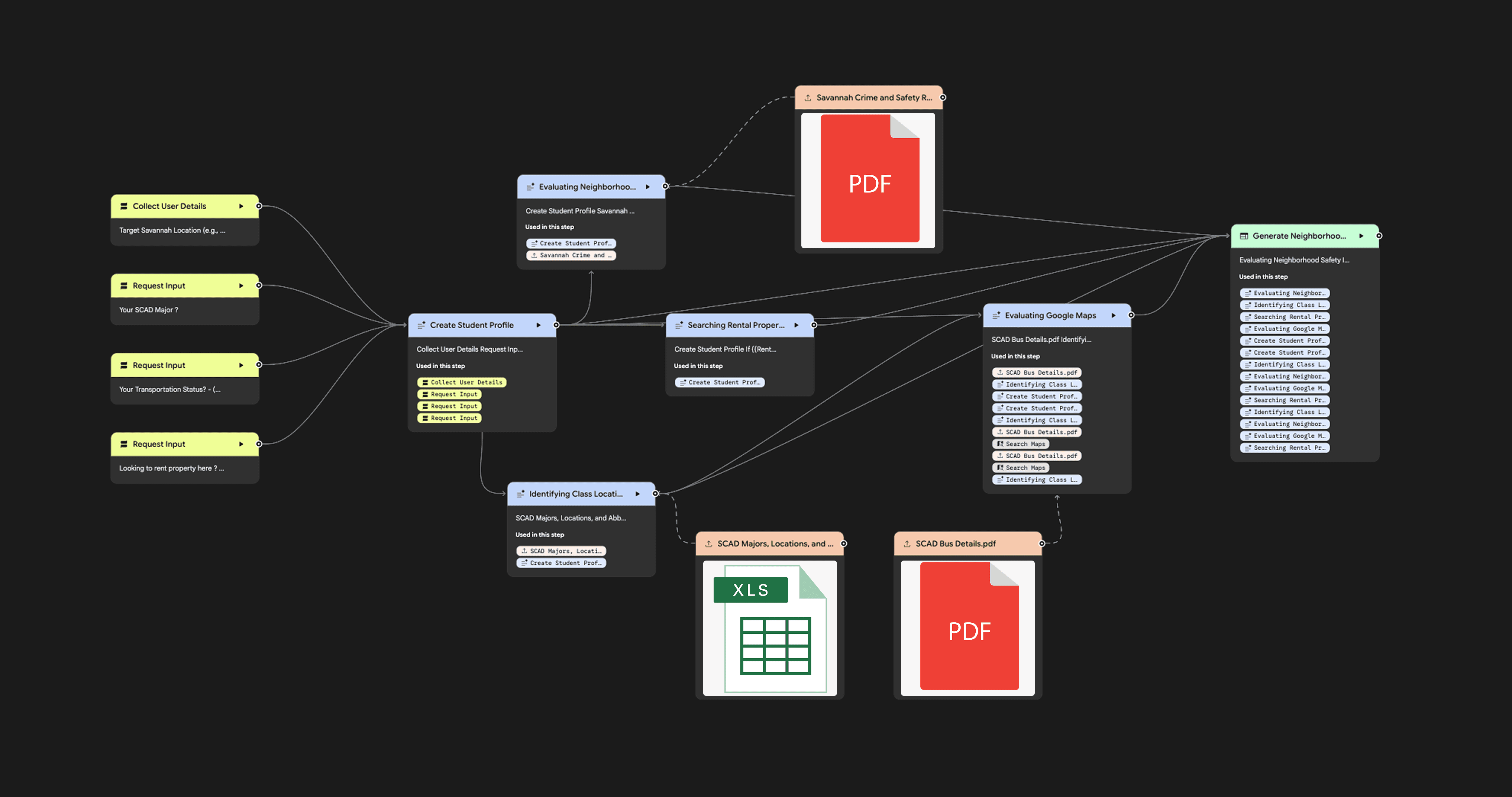
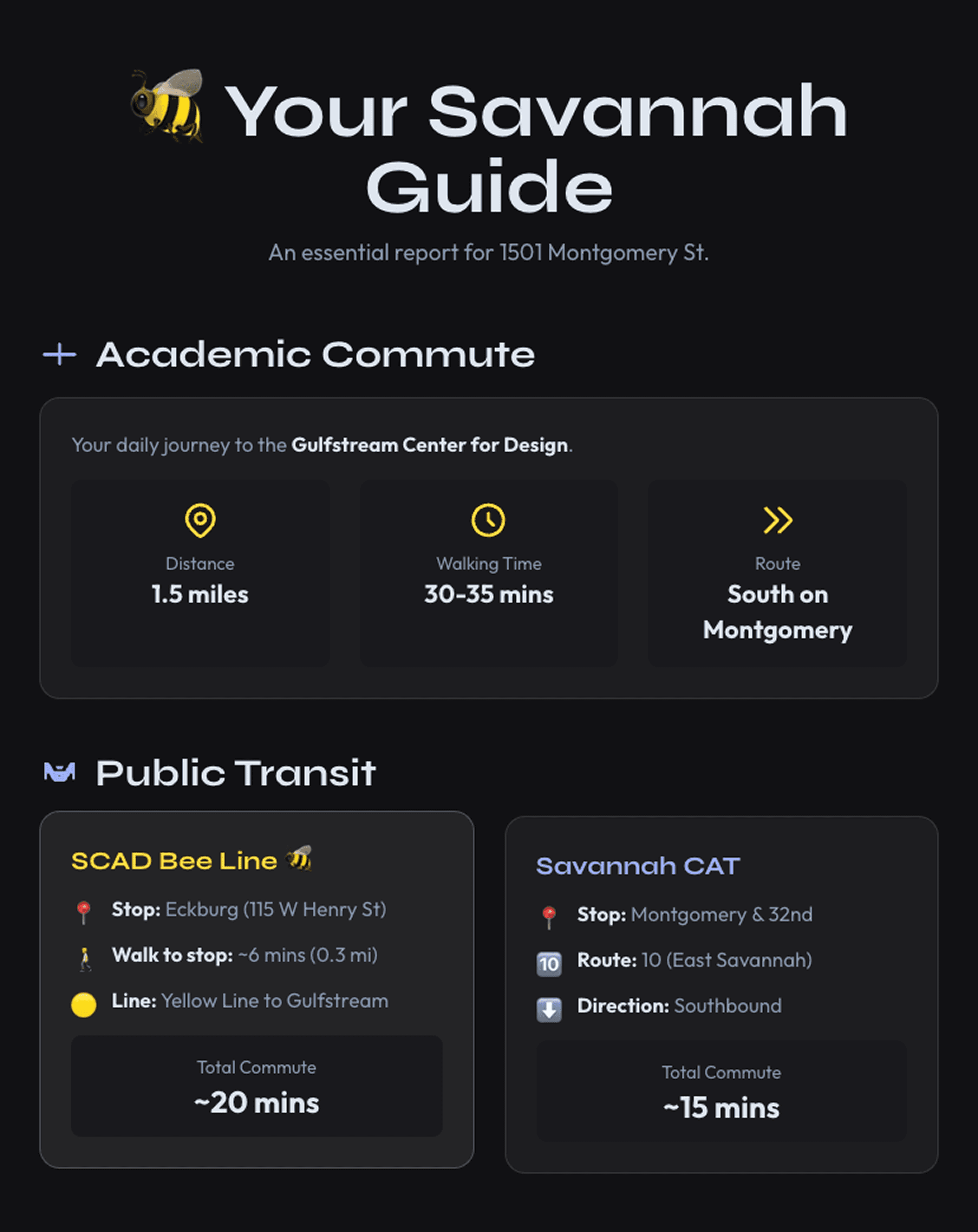
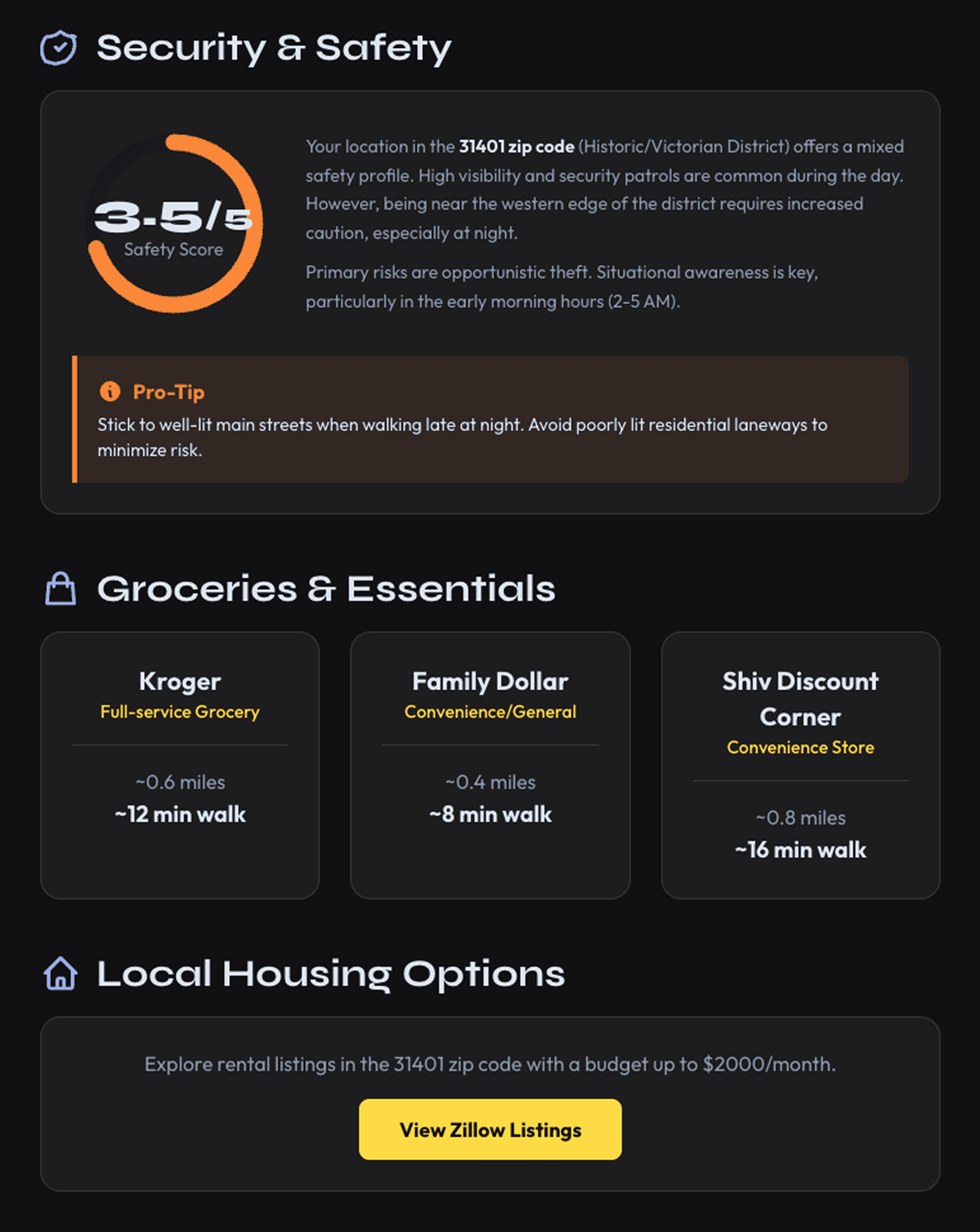
I developed a no-code AI agent that automates the "neighborhood discovery" journey. The solution uses a centralized Data Hub to process user inputs and triggers parallel logic streams: mapping academic buildings by major, extracting safety scores from proprietary research, and fetching live transit schedules. The final output is a dynamic, scannable digital report that provides immediate, actionable clarity on a student's potential neighborhood.
I developed a no-code AI agent that automates the "neighborhood discovery" journey. The solution uses a centralized Data Hub to process user inputs and triggers parallel logic streams: mapping academic buildings by major, extracting safety scores from proprietary research, and fetching live transit schedules. The final output is a dynamic, scannable digital report that provides immediate, actionable clarity on a student's potential neighborhood.
I developed a no-code AI agent that automates the "neighborhood discovery" journey. The solution uses a centralized Data Hub to process user inputs and triggers parallel logic streams: mapping academic buildings by major, extracting safety scores from proprietary research, and fetching live transit schedules. The final output is a dynamic, scannable digital report that provides immediate, actionable clarity on a student's potential neighborhood.
VALUE DELIVERED
VALUE DELIVERED
VALUE DELIVERED
SCADhood transforms hours of manual research into a 30-second automated experience. It provides students with spatial certainty, ensuring their home-to-class commute is viable whether they walk, bike, or use the Bee Line. By grounding recommendations in objective safety data and real-time Zillow listings, the tool empowers students to make informed financial and security decisions, significantly reducing the cognitive load of international relocation.
SCADhood transforms hours of manual research into a 30-second automated experience. It provides students with spatial certainty, ensuring their home-to-class commute is viable whether they walk, bike, or use the Bee Line. By grounding recommendations in objective safety data and real-time Zillow listings, the tool empowers students to make informed financial and security decisions, significantly reducing the cognitive load of international relocation.
SCADhood transforms hours of manual research into a 30-second automated experience. It provides students with spatial certainty, ensuring their home-to-class commute is viable whether they walk, bike, or use the Bee Line. By grounding recommendations in objective safety data and real-time Zillow listings, the tool empowers students to make informed financial and security decisions, significantly reducing the cognitive load of international relocation.
APPROACH
APPROACH
APPROACH
My approach focused on modular logic and data grounding:
Architecture: I designed a Linear-to-Parallel workflow in Google Opal to ensure data consistency.
Centralization: I built a Student Profile Doc as a "Single Source of Truth" to prevent variable drift across nodes.
Knowledge Integration: I integrated proprietary PDF research (safety) and live web assets (SCAD Bee Line) to ground AI responses in factual, local data.
Conditional Logic: I implemented transport-specific branching, allowing the agent to pivot between cycling, driving, and transit calculations based on user status.
My approach focused on modular logic and data grounding:
Architecture: I designed a Linear-to-Parallel workflow in Google Opal to ensure data consistency.
Centralization: I built a Student Profile Doc as a "Single Source of Truth" to prevent variable drift across nodes.
Knowledge Integration: I integrated proprietary PDF research (safety) and live web assets (SCAD Bee Line) to ground AI responses in factual, local data.
Conditional Logic: I implemented transport-specific branching, allowing the agent to pivot between cycling, driving, and transit calculations based on user status.
My approach focused on modular logic and data grounding:
Architecture: I designed a Linear-to-Parallel workflow in Google Opal to ensure data consistency.
Centralization: I built a Student Profile Doc as a "Single Source of Truth" to prevent variable drift across nodes.
Knowledge Integration: I integrated proprietary PDF research (safety) and live web assets (SCAD Bee Line) to ground AI responses in factual, local data.
Conditional Logic: I implemented transport-specific branching, allowing the agent to pivot between cycling, driving, and transit calculations based on user status.
SUMMARY
SUMMARY
SUMMARY
SCADhood is a high-impact Design Management solution that leverages AI orchestration to solve a critical onboarding friction for the SCAD community. By automating complex data synthesis, the project demonstrates how no-code tools can be used to build empathetic, localized services that bridge the gap between institutional data and individual user needs.
SCADhood is a high-impact Design Management solution that leverages AI orchestration to solve a critical onboarding friction for the SCAD community. By automating complex data synthesis, the project demonstrates how no-code tools can be used to build empathetic, localized services that bridge the gap between institutional data and individual user needs.
SCADhood is a high-impact Design Management solution that leverages AI orchestration to solve a critical onboarding friction for the SCAD community. By automating complex data synthesis, the project demonstrates how no-code tools can be used to build empathetic, localized services that bridge the gap between institutional data and individual user needs.